Over the winter, I had a late night conversation with a friend who lives abroad. Toward the end of our chat, she shared something intriguing and heart-warming about this newsletter. She said (and I paraphrase):
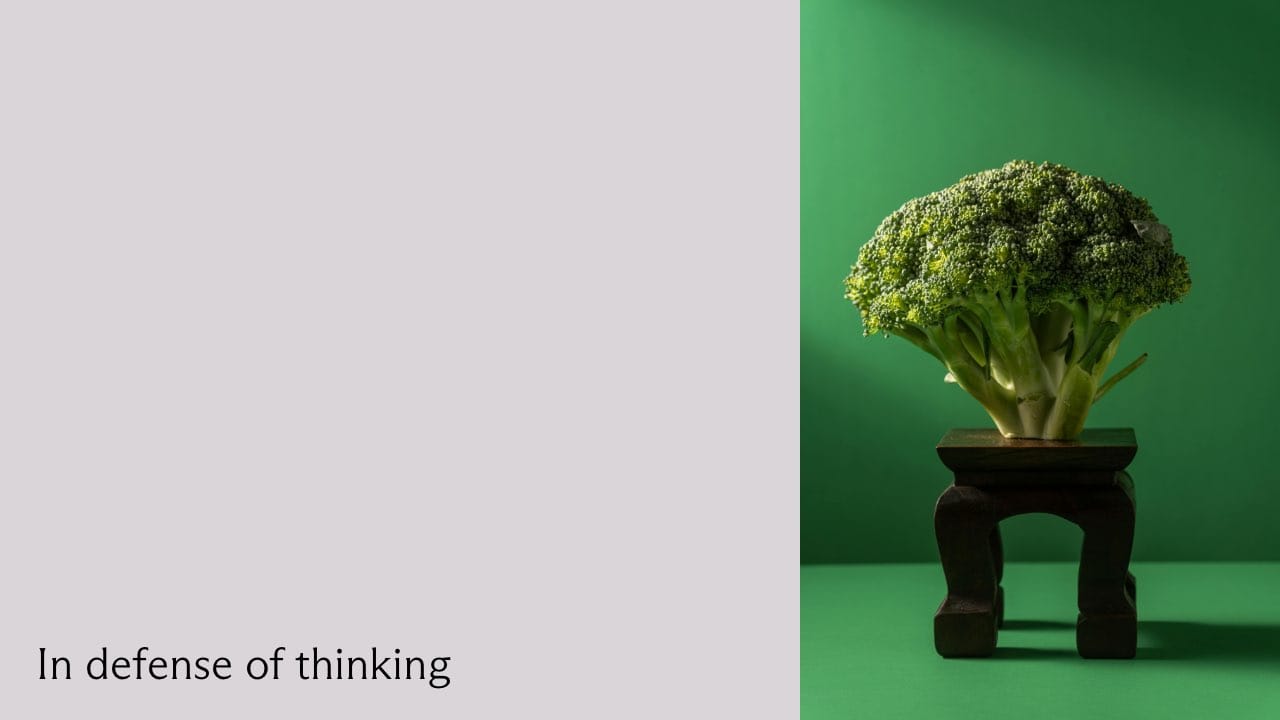
"The thing about your newsletter is that it takes time to read, so I can't just glance at it. I need to be in the right headspace. And it's like... it's good for me. I know it's good for me when I read it. Kind of like when you eat clean food."
Her words trailed off, as she looked for the right analogy to land her point. A wide smile started to form on my face, which of course, she couldn't see.
Her compliment reached me. I didn't deflect it. It was meeting me at my intention-level: wanting to produce and share thoughtful, even useful, writing. Her reaching for a metaphor became a gift in itself.
Personal essays, the kind I share here regularly, have an arc to them. They are meant to be more than a story, just as they are meant to bring you to a reflection. Translating her words, I think she was telling me: your writing makes me think, the kind of thinking that I know is good for me.
And then I thought: that may be the best description of The Mettā View anyone has ever given. Better than anything I've written on a landing page. Certainly honoring my intention.
Making the analogy that much sweeter, I should tell you I'm big on my actual greens. I've followed a mostly plant-based diet since 2015, first for health-reasons (to help me manage an auto-immune disease, and it's working brilliantly) and eventually, by taste. I love to dress up my vegetables in fancy ways, and at the heart of me throwing events at my home was a desire to titillate my guest's brains as much as their palates when they attend one of my salons.
So the greens analogy fits the bill — and yet I'd been a little coy about claiming it. Until today.
But earlier this afternoon, a computer science professor at Georgetown's analogy about what not to feed our brains helped me land mine with a satisfying thud.
Cal Newport, the famed author of “Deep Work” among other bestselling titles, has penned an op-ed for the New York Times. And what a piece it is: "There’s a Good Reason You Can’t Concentrate"
Newport frames our current attention crisis by taking us back to a time before the current and widely accepted guidelines to eat healthy and exercise. Citing research, he explains that our attention spans are only one-third as long as what they used to be in the early 2000's. Have we reached peak human brain power?
It's notable that productivity growth stagnated since the 2010's, and I'm sure you can see why. Overwhelm, exhaustion, busy work. General dissatisfaction. And yet we stare at our screens, stroking the fetish as I once heard Esther Perel refer to our phones. And when we let them go, they ping us back, a relentless loop keeping us in tamagochi-feeding mode. As if our devices needed us.
But there's more than output that decreases with us unable to concentrate.
Earlier this week, I felt it myself, that thinking-through-sludge sensation, unsatisfying and dense (and yes, I'm aware that peri-menopause is probably not helping). I'm sure you know what I'm referring to. The analogy with health and exercise suddenly feels very sharp: here I am, pushing my inner cogs to turn, an exercise in willpower not unlike what you'd see me push myself to at the gym after a giant meal. The challenge is real.
Newport offers:
"Thinking is what lets us make sense of information in a complicated world", and later: "Thinking is also an engine for making sense of our lives and cultivating our moral imaginations."
Here's something that reframed how I think about my own mind, discovered in the pages of the book From Strength to Strength by Arthur Brooks: psychologists distinguish between two types of intelligence. Fluid intelligence, the ability to process new information quickly, hold things in working memory, solve novel problems, peaks in our mid-twenties and gradually declines from there. Crystallised intelligence, think accumulated knowledge, judgment, wisdom, the ability to see patterns across a lifetime of experience, which grows well into mid-life and beyond. We're not getting stupider as we age. We're getting different. Deeper, arguably.
But here's what worries me, and this is my own interpretation, not Newport's: the cognition crisis isn't only eroding our fluid intelligence. If we can no longer concentrate long enough to read, reflect, and connect ideas, then even our crystallised intelligence starts to thin. We stop making meaning. We may lose the ability to pull the threads that nourish our inner lives, and when that goes, so does our capacity for deep connection, with ourselves and with others.
Current technologies are conspiring to weaken our attention first, making it harder to invest ourselves into any kind of deep thinking. Newport goes further: he argues that social media and email had already weakened our capacity to think before generative AI arrived, and that the more we use AI to avoid mentally demanding tasks, the more our cognitive fitness degrades. We are creating the conditions to become lesser than the machines, if we don't reclaim our brain power.
But It's not all doom and gloom. The cognition crisis could be overturned.
Newport reminds us of the strides made around health and fitness in the past fifty years. Using a similar approach, limiting whatever diminishes our cognitive fitness, and committing to tasks that support our thinking (like reading, writing our own emails (!) and not outsourcing our creative work to AI, could overturn the current trend.
What if we fed ourselves what our brains need, instead of digital Frankenfoods?
"What is a TikTok video if not a digital Dorito?" he asks.
As I heard this (I was throwing the ball at my dog while listening to the article), I emitted a little yelp and I may have started clapping. YES!! That's right. We need to remove the digital Frankenfoods from our diets, eat our greens and exercise our big beautiful brains. Before they start to atrophy.
Next time you grab your phone to open TikTok or Instagram, think of the worst kind of processed food you can come up with, the kind that makes you feel terrible afterward.
Let this remind you about how you nourish yourself, in what ratio; what makes you happy, makes you feel good. Consider, as I am learning to do, putting the same amount of care in what you feed your mind as what you do to nourish and look after your body.
So I'm adopting the term. Officially. This newsletter is your greens. 🥬
You won't always be in the mood. You might need to save it for later. But when you sit down with it, I hope you'll feel better after.
Thanks for being here, and if you ever want to tell me what The Mettā View is like for you, drop me a line. I'd love to hear from you.
Warmly,
Anne
P.S. If you know someone who could use more greens in their diet, forward this their way. 🥬
A note on links: much of what I share comes from publishers who operate behind a paywall. Some, like the New York Times and the Financial Times, make it relatively easy for subscribers to share a handful of articles — others less so. I'll always do my best to provide free access. Where I can't, I'll look for an alternative, like the short clips many newspapers now share on social media.
The Cal Newport article is indeed available as a gift via this link.