“When people show you who they are, believe them; the first time.” - Maya Angelou
On a sunny Sunday, a couple of weeks ago, I was supposed to engage with dense required reading for a course I’m enrolled in. Sprawled on the comfy charpoy located on my balcony, my body and mind started to drift softly under the heat of the midday sun. My eyes were about to close when a Substack notification on my iPad screen caught my attention.
Adept at swiping up and toggling on silent mode, I surprised myself, and in a move that looked like procrastination, I opened the message.
A long written post opened, by the author Dr Sharon Blackie, an award-winning, internationally best-selling author, psychologist and mythologist, known for The Enchanted Life among other titles.
“Dear friends," she wrote,
"This probably won’t be surprising to many of you, but I’ve decided to move my longstanding publication, The Art of Enchantment, off Substack. (If you are surprised, you can read about why I’m jumping ship in the section at the end of this missive. I hope you’ll find it illuminating.)”
I couldn‘t NOT jump to the end of the email to find out why the author was (finally, rightfully) making this choice.
Note that I am making an assumption at this moment: do you know Substack? If you don’t, hang on.
Substack was originally designed as a simple email newsletter platform. The main point was email delivery, with a no frills editor tool, the possibility of monetising via subscriptions, and a simple home/archive page, where readers could come and discover your writing.
This was a place marketed at ‘serious’ writers, people who like words, long-form. I’m all about longform (something you must know by now) so I too joined Substack in January 2022, having found other email platforms (namely Mailchimp and Flodesk) annoying and fiddly. And pricey too.
By joining Substack, writers were also bringing their own audience on the platform. But while Mailchimp and Flodesk were tools for delivery, Substack was a hub, with an app and growth tools to entice new readers to engage with varied writers.
It was initially lauded: Substack turned broadcast emails into budding communities where audiences received newsletters in their inbox but equally could like, comment, engage on each publication’s homepage. Words were no longer left echoless in the ether. The online platform became considered as a haven, one where we could take time to read. Depth of thought was implied. A safe place to work out your neurons, build your attention span back to pre-TikTok levels.
But (you knew that "but" was coming) the company decided to change direction. Its leadership made decisions that irked many, including myself.
Read Substack’s mission statements four years apart:
In 2022: “Substack helps independent writers publish directly to readers and make money through subscriptions.” In 2026: “Substack helps creators grow subscription-based media businesses by publishing across email, the web, and Substack’s own discovery and social features.”
WHEN MY VALUES ARE RUBBED THE WRONG WAY
Now I can’t call myself an innovator but I’m certainly an early adopter. Curiosity for tech and trends leads me to try new things soon after they come out. Why, I don’t know, I’m built this way we could say. In parallel, I have a strong sense of what I stand for, certainly because I write about values, about resonant storytelling. And because I advise creatives and leaders on business development, strategy, weaving those intimately with their values, to support them in making the right choices for who they are.
I couldn’t tell you when I became aware of this, but one example that disturbed me from Substack is their standard post-subscription message. They have this thing where as soon as you click that subscribe button, it will show you that this person/publication that you decided to invite into your inbox is recommending three other people/publications.
Right. The three recommendations may be great but I don’t know them, we don’t know them.
My gripe lies mainly with the fact that the boxes are checked by default. It‘s effortful to untick all three boxes. The experience seems designed to have us subscribe by default to more emails (or notifications) from people we don’t know.
Next, Substack’s flow leads to: ‘Hey, you’ve just subscribed to XYZ, would you like to recommend it to your friends?’
Remember, it’s a brand new relationship. I don’t know this publication. I just hit that subscribe button. Why would I recommend it? Uh, no!?
If you don’t feel outraged yet, here’s an analogy.
Let’s say you‘re on a dating app.
You swipe right on someone attractive. Boom, that person recommends three more people they like. By default, it’s opting you in. In a single move, you’re swiping right on all three of them. The app designed this screen for you to say yes, but you can’t see their profiles, just a name and a thumbnail.
Would you want to? Probably not.
And next frame, the app suggests: ‘Hey, you swiped right on so-and-so, would you like to recommend them to your friends?’ Huh. NO?!
So I make a conscious choice NOT to recommend and NOT to subscribe before reading. The same way I wouldn’t offer reviews to a restaurant whose cuisine I haven’t sampled.
Substack seems to be designed around what I call an “empty” subscriber count: newsletters from people we don’t know, which we delete, or unsubscribe from not even knowing who wrote them.
SMALL ACTIONS AND THE EROSION OF TRUST
Dr Blackie and I shared the same understanding when we joined, though I landed on the platform with 200 readers, while she brought in 23,000. Her reasons for leaving was about to reveal a gap I hadn’t noticed in my own inbox.
In her post, she wrote:
“[…] in that once-brave new world, the Substack model was founded on writers having a meaningful relationship with their audience too, through direct-to-inbox emails. Just like the proper newsletter lists we’d all grown up with – which is why those of us with healthily sized lists we’d already spent years/decades building up and couldn’t afford to lose, thought we’d be safe coming over.
We weren’t.
Nowadays, you can be actively subscribed to a writer on Substack and not only choose never to receive a single email from them, but also never even see a single one of their articles on the website or in the app. People here who have emails disabled can be subscribed to dozens of publications, with articles they can’t possibly be finding the time to read piling up, invisibly lurking in the ‘subscriptions’ tab on their Substack profile page. ”
I paused. “Huh? Come to think of it, I haven’t received any essays from my favorite writers, like Elif Shafak.” A quick scan through my inbox confirmed it. No emails since April.
Had it not been for Dr Blackie’s post, I wouldn’t have gone to Unmapped Storylands, the Substack homepage of Shafak’s newsletter. Lo and behold, she had continued to publish regularly, yet had disappeared from my inbox.
A flush of outrage coursed through me.
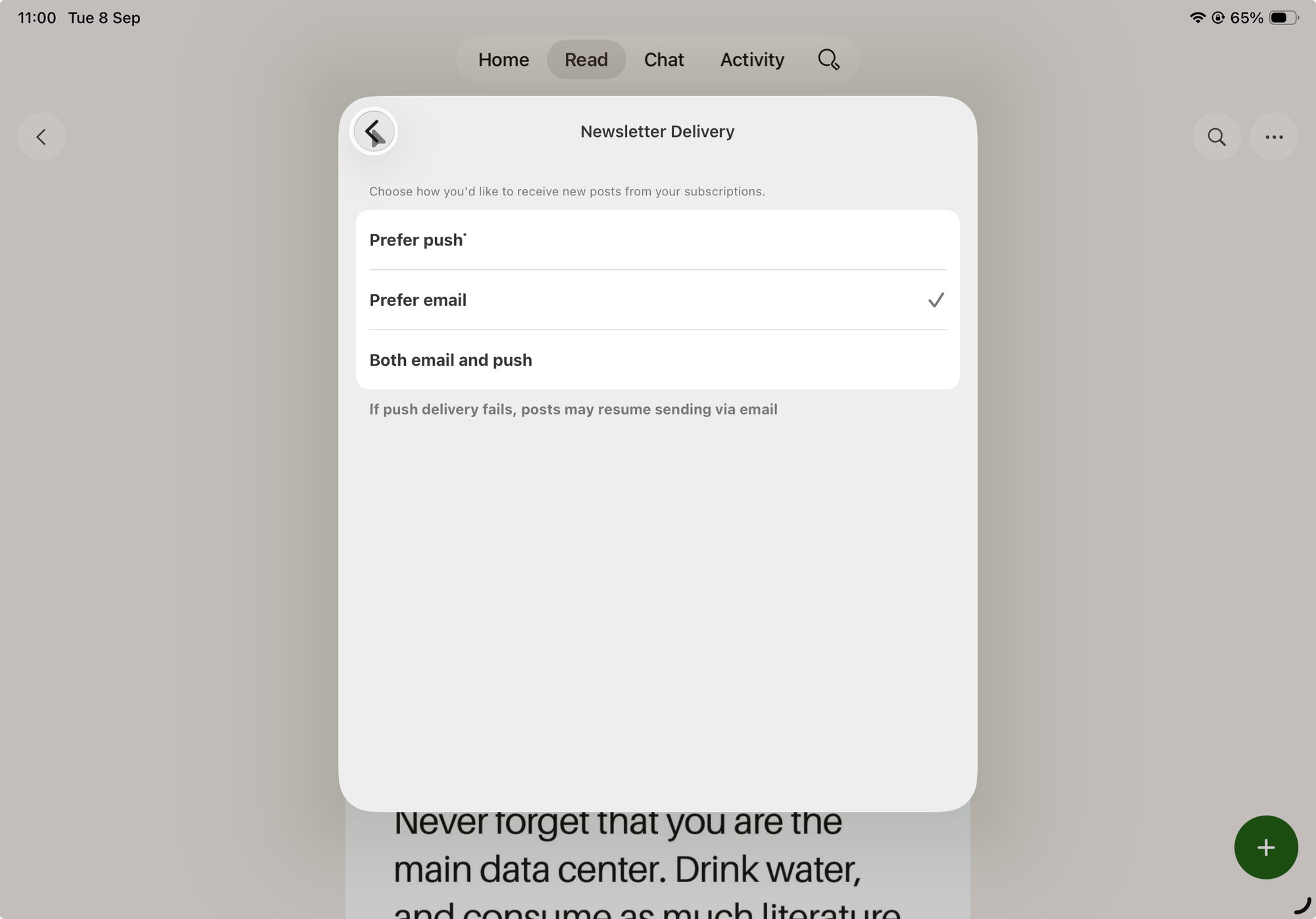
After a quick search with Perplexity AI, I learned of Substack's push to drive more engagement through their app, took to the app settings, and indeed, I found that my global preferences were on … notifications. For someone anti-notifications, this was mortifying.
Somehow most of my subscriptions had been moved to an app-first delivery system. Not all, but most. How that happened, I can't say.
I hadn't cancelled my subscription to those writers; I stopped seeing their work.
Days later, I am still unable to tell you whether this happened when I downloaded the app on my phone or iPad (I think iPad), or how I may or may not have reset the platform settings unwittingly. Or if Substack pushed me and others to this app-first option without our consent. All three, probably.
Since changing the settings back, my inbox has been flooded by publications and writers I thought had simply stopped putting out their writing. After all, not everyone is consistent when it comes to publishing online. I had no way of knowing.
This shift in delivery away from the original promise made by Substack feels like a breach of contract between me and the platform.
But it doesn’t surprise me. Trust was already low back in 2024. When the design led to further changes in discovery, notes, and follows, it plummeted further.
Inflated numbers mean nothing when people never see/read your words.
Anyone on Instagram knows that the algorithm, by default, wants people and businesses to pay to access your feed. It’s media now. Just media. Social lives elsewhere.
Crucially, these spaces don’t belong to us. If the platform changes, any investments made (time, creative, exchanges) stay on it. Substack went media heavy, in the same vein, but in so doing, disenfranchised its writers.
Dr Sharon Blackie adds:
“if you show interest in our work but only ‘follow’ us, then when we leave, just like when we leave Instagram or X, we can’t take you with us. You’ll never see us again. And that’s the exact opposite of what Substack once repeatedly promised us.”
I’m not saying that tech platforms shouldn’t evolve, or that a mission, once stated, should stay forever fixed. My case is to watch out for the intention hidden in the small actions executives take.
And if you’re an executive, I’m arguing for clearer communication and a more empathic stance toward us, your people, whether you refer to us as users or customers.
Substack wants me to open the app regularly. For me to spend my time in feed and notes. I don’t. Substack wants to generate subscriptions, push for more, but I don‘t want ’more.’
Quality. Not quantity.
Our attention is scattered. Time is a precious resource. Where I put my attention is a choice.
Away from the follow follow follow. More more more. And yes, also Andrew Tate on the platform.
IS THE SUBSTACK MODEL STRONG?
Let me answer not as a newsletter writer, but as a consumer of media who I pay for media (I even support free media like the Guardian), think multiple subscriptions with multiple outlets. I curate my sources with care and read from them daily.
I will buy Sharon Blackie’s books but I won’t pay for her newsletter. Same for Elif Shafak (and I love Elif Shafak, I not so secretly wish we were best friends). My engagement with these writers and their work lives outside of Substack. I love them and I really don’t want to pay for a subscription.
I’ve only ever paid for three Substack newsletter subscriptions over four years. Only one of them currently still counts me as a paid subscriber.
If I, Anne, who spends so much of her time writing and reading online and in print, who respects quality and depth and supporting talent doesn’t put money on the platform, I ask you: who will?
Lastly, I don’t believe Substack will remain the home of independent writers. We are already paying for subscriptions to everything else: apps, streaming, software, news outlets. Writers deserve to be paid, but I argue that a subscription isn't the way to support them. We suffer from subscription fatigue and we are tired of renting the internet in monthly installments.
FYI I can spot the paradox: I'll pay for the Guardian and the New York Times, but not for independent writers on Substack. There's more to say about that, but that's another topic, for another essay.
So no, in my view, not a strong business model.
It's best suited to writers and creators who want a free email distribution service and a home for their work. They should still watch out for the hidden cost, that of their work not being delivered to inboxes, but becoming another push notification on our phones instead.
WHERE DOES THAT LEAVE US?
This leaves me and Sharon Blackie in the same place, despite the mismatch in our audience size (I've grown my list, but nowhere near her 63,000).
This isn’t a story only about writers. There’s a word for what’s happening with Substack, coined by Cory Doctorow, called enshittification.
Enshittification here stands for what happens when a platform goes from serving its users to serving itself. You may know the feeling, without having known the word. That moment when you realise ‘I used to love this’ before thinking ‘what am I doing here exactly? I don’t understand what it does for me.‘
Several years ago, I deleted my Twitter account after the platform was bought by you know who. Before I pressed that delete account button, I felt a sting of annoyance at giving up my handle @annvi, and my history on the platform. But then I remembered why I was quitting. I know what I stand for.
My choices, my actions, reflect what I value.
This is true of your choices. Just as it is of Substack’s.
I hope we can all remember Maya Angelou‘s words.
“When people show you who they are, believe them; the first time.”
Until next time,
Warmly, Anne
PS. It’s fitting that what I thought was procrastination led me to write this essay. And that the mechanism was delivered by a Substack notification. Life is funny like that.
PPS. LinkedIn is the latest platform that seems to have seriously enshittified itself in the past couple of years. I post because I must. Am I the only one thinking like that? Should I stay or should I go?
DIVE DEEPER
It’s one thing pointing the finger to bad examples, I felt I owed you a good example to reestablish a sense of balance in humanity and tech alike.
A few months ago, I turned away from my calendar booking tool, Calendly, after being disappointed with their customer service and communication.
I looked for multiple alternatives, but having moved to Swiss-based encrypted email tool Proton, there was only a single calendar management platform that could operate (minimally) with Proton, called Cal.com. Having no other choice (the Proton move was made), I onboarded to their European tool, Cal.eu. I should note, the account is free when you are a single user.
A few problems arose. Mistakes I made, and bugs with the system. This was met by their super effective and fast responding customer support team. It’s been less buggy for the last few weeks but also I didn’t mind that much. Because I was heard. Taken care of.
I went from someone who didn’t particularly care about Cal.com to someone who respects and actively recommends Cal.com.
I don’t know those folks, but I like the decisions they made. Here’s an email they sent out a few weeks ago, which made me like them even more. I hope this inspires you/your communication.
Example of strong change communication from the co-founders of Cal.com
hey it's peer from cal.com / cal.eu. we are thinking about moving every user from cal.eu to cal.com, as we no longer feel like we can provide the best service running two separate instances. we originally launched cal.eu to give European users a home that didn't want to be on cal.com, but we quickly realised we can't really keep up with the demands of running two separate platforms in parallel. after investing a lot of sweat and tears into this standalone platform, with a heavy heart we are considering shutting down cal.eu and help every one move to cal.com, our international platform (it's also fully SOC2, ISO270001, GDPR-compliant) my cofounder Bailey and I are both Europeans. Bailey is British, born near London and I was born close to Hamburg in Germany. we take data privacy and data security extremely serious, unlike some other american companies in the past. *cough* facebook *cough* migrating from cal.eu to cal.com is obviously a choice you have to make, we would never transfer any data without your consent. i'm reaching out to reply to any question you might have, and any way I can be of assistance. it's a hard decision, nobody likes to shut down services, but we feel like we have to make this to double down on the bext experience on cal.com. we haven't fully decided this yet, i am open to hear your thoughts: - are you ok with this? - are you extremely angry? would love to learn more. migration wise, if we do decide to shut down cal.eu we intend to make it as easy as possible to move from .eu to .com with as little interruptions to your service as possible. if this is a deal-breaker, i am here to help you move to a different company, maybe another European-hosted alternative. best wishes, Peer, Bailey & team
ALTERNATIVES TO SUBSTACK
If you're thinking: but I want to stay on the platform, it’s annoying to move. Yes, it’s always annoying to move, whether you are doing it IRL (like my brother, last weekend) or online.
Moving makes sense when your needs are not met (emails not landing in inboxes) or when you feel unheard/unseen (my Calendly example above).
There are great alternatives to Substack out there, but you need to know what your needs and objectives are before you make a choice.
Great alternatives I’ve explored: Beehiiv (chosen by Dr Blackie)
Ghost (my choice, ethical, monetisation possible, sequencing, custom-built website possible)
For writers who are told that they need to build ‘their’ platform and their presence, what matters most is how engaged your readers are. An audience of 10,000 who never see your emails is worth little for the success of your book.
REPORTING AND OPINION PIECES ON SUBSTACK
2021, The Observer: Trans writers such as Julia Serano found themselves signed up to anti-trans newsletters they'd never chosen, as a form of harassment, made possible because Substack's subscriptions didn't require confirmation.
2021, TechCrunch: The science journalist and novelist Annalee Newitz left the platform, calling Substack a "scam" for secretly paying a select group of writers.
2023, The Atlantic: Jonathan M. Katz reported that Nazi and white nationalist newsletters had thousands of subscribers on Substack, many of them paying, with the platform taking a 10 percent cut.
2025, User Mag: Taylor Lorenz reported that Substack sent a push alert encouraging people to subscribe to a Nazi newsletter; the company called it an error and apologised.
2026, The Guardian: An investigation found Substack earning revenue from Nazi newsletters, and within two hours of subscribing to one, its algorithm pointed the reporters to 21 similar profiles.
2026, The Art of Enchantment: Dr Sharon Blackie on why she moved her publication, and what happened to delivery along the way.
2026, Wild Lionesses Pride: A lesbian, non-binary writer in Germany found Andrew Tate among Substack's bestseller recommendations even after blocking and reporting him. Shortly after, he disappeared from those recommendations. Then she paused on the pattern:
"I want to pause on something. The pattern of who Substack hosts — people ejected from every platform that assessed its European legal exposure and complied — starts to resemble a market strategy. Whether Substack actively courts the European ultra-right and figures like Tate as a growth sector, or whether they simply remain the last major platform willing to carry them, the outcome lands identically: Substack gives reach to people European law worked specifically to contain. I notice the pattern. I’ll let you draw your own conclusion."