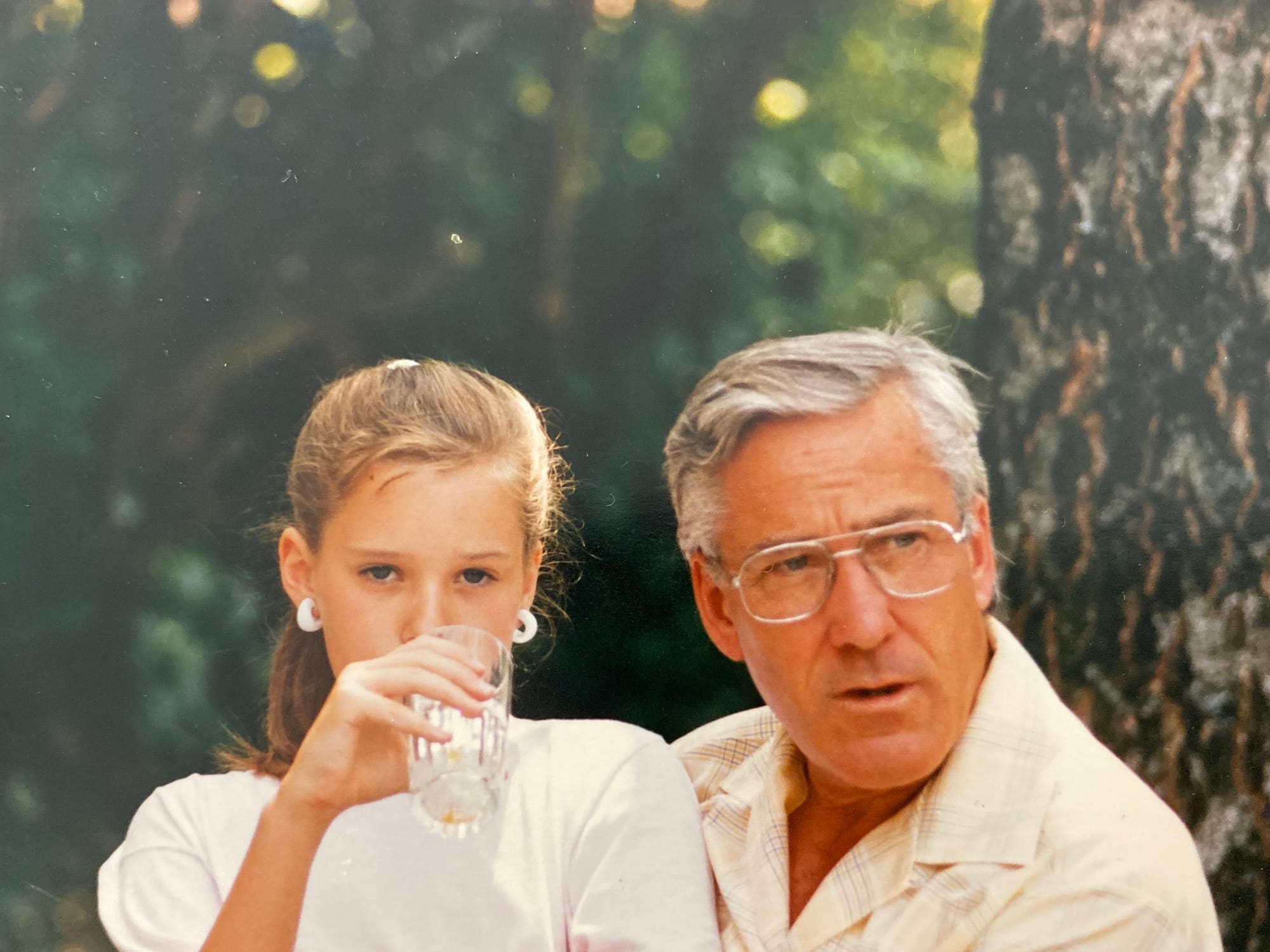
I grew up, very much my father’s daughter. The successful OBGYN and surgeon, though unremarkable in stature, more than made up for it with his glinting blue eyes and jovial smile. A silver fox (according to the women in our neighborhood who tossed their hair near him), he enjoyed his bespoke tailoring as much as he did joining the local farmers for the wheat harvest every summer. Despite his warm demeanor, he also possessed a severity that revealed itself at home through his booming voice.
Children of a second marriage, my younger brother and I were treated to a mellower version of him, less iron fist, more velvet glove, age having done its work. "Ce que l’on conçoit bien s'énonce clairement. Et les mots pour le dire arrivent aisément" , a quote from French author Nicolas Boileau, written in 1674, and which essentially translates as: “What is well understood is clearly stated. And the words to express it come easily.“
My father delivered this French saying to my face on more than one occasion, whenever I failed to put my point across to him.
The situation generally revolved around a bouncy tween Anne (actually, Virginie, my family I has always called me by my second name) excitingly pleading for something she wanted, and with my father cheerfully turning me down. Upon hearing the dreaded ‘no’, I’d throw myself into arguing why I was of course right, right right to ask for the thing, whatever the thing was! The vehemence of my speech failed to persuade my father. The rising heat of frustration, visible through my furrowed brow, eventually clouded my thinking. I’d trip on my words, bruising my ego in so doing.
Why can’t I get it out ‘right’, I’d think to myself.
I believe that my father administered the Boiileau saying conscious of the sting that its wisdom would deliver. He didn’t mean real harm by it, yet I nearly growled whenever I heard it. This pointed to my unacceptable weakness: the more I was trying to argue for myself, the more flustered and less convincing I became.*
Boileau, whose words still resonate centuries later, felt, obviously, true to teenage Anne.
When expression feels stuck, or falls flat (to reference my earlier essay), it’s because the inside of our mind have become hard to navigate.
Tween Anne would snap a few quips in response, with the view to cause at least some irritation on the father side. Invariably though, this tactic backfired. My father’s face would turn bright red, the roll of his laughter reverberating from his belly all the way up to his face, tears spilling out behind signature silver rimmed glasses.
This sent my head spinning. There were no doors to slam in our open plan living space and boy, did I regret the configuration of our house on those days. I stomped my way up the maroon carpeted stairs, the ones that my mother made me clean every morning during the holidays. In thick steps, I marched down the upstairs corridor just to have the satisfaction of slamming my dark green wooden bedroom door shut, the distance removing much of the dramatic effect I was vying for. Behind me, my father, still laughing, calling out: ‘Virginie, reviens (come back!), I promise I’ll listen.’
My father followed me up the stairs, offering me a tight hug along with an apology for his response. This didn’t stop me from sulking. In retrospect, I did get my way most of the time, back then.
You could rightly conclude that the story I just told you was about unclear communication. That’s what the memory offers first, because of the quote, because of the shape of the argument.
But then I stayed with it a while longer. What was I remembering, really? What else was there for me to see, to uncover?
The stakes that amplified my nerves, the reason why I was tripping on my words.
The excitement. How much I wanted the thing that I wanted (though not anything of importance, given that I have no memory of what the thing was).
Then the sting of the response, my father delivering the quote pointing me to a failing.
Him laughing at me, when what I wanted was to be heard. Encouraged. Listened to. Even if I wasn’t going to get the thing I wanted to get.
As I explored this memory-story, this other one surfaced. And later, to my surprise, I realised they were related.
My younger brother, when he was learning to speak as a little toddler, famously got into fits of rage when his first words failed to come out smoothly, aka when his first attempts to form sentences to expressed his needs and desires in gargled speech failed to be understood by our mother.
This stage allegedly lasted a little over a fortnight, yet legend has it that his little face turn purple, mouth agape, juicy tears bursting sideways out of his blue eyes, his hands pulled into tight fists grabbing onto the dining room tablecloth, where lunch was awaiting.
On several occasions, his rage had him attempt to pull it all down, the glasses and plates and crockery and my mother’s delicious food, to have us feel, with a big crashing display, just how hard it was for him not to be understood. In the middle of his meltdown, the word ‘nooooo’ escaped in a wail. Not that! This is not what I meant, his trembling body screamed.
Invariably, my mother reached her hands out to him, kneeling close, bringing him tenderly toward her chest, where she held him while he would rage-wail a while longer. ‘It’s okay, I know it’s really hard for you, it’s painful not to be understood. It’s okay, you’re okay,’ she whispered to him, alternating between stroking his hair and patting his back.
Crucially, I see how she moved toward his pain, acknowledging his difficulty. His face buried in her long blond locks, his breathing slowly returned to normal, the colour of his cheeks softening back to his natural peachy shade.
In today’s world, I see the frustration, the suffering, and the anger, in grown up toddlers and former tweens. Thankfully, we don’t take it out on the tableware as seasoned adults. Though, I sometimes wonder whether we should. The feelings are no less real than that of my toddler sibling.
When I look back, what shines with significance for me was how in both these scenarios, my brother and I were allowed to feel our feelings. We didn’t push them down. Of course, one of us was met with laughter, a glossing over of the need that was expressed, at first. * The other with a caring acknowledgement of the difficulty.
I love that my brother and I felt secure enough and free enough to express those big fiery emotions. The aaarrrggghhhhhh, the slamming of doors, the clenched fists, the torrents of thick tears.
These stand out in a stark contrast when I catch a glimpse of myself as an adult.
Maybe the hardest thing we face as we get older is the steady adaptation that has us swallow and ignore our emotions. I’m not talking about self-regulation (in itself a great skill). I’m talking about its shadow side, the ‘saving face’, as in let me cover up how your words or actions affect me. I think of as a taught numbness.
I learned this at home first. During my teenage years, my mother began to suffer from mental illness. I learned to walk on eggshells, cautious with my voice, my words, careful not to be the one to tip her fragile state of mind.
Later, at twenty-four I became a shop girl, paid cash on hand, in a cute boutique in Knightsbridge. Over a decade of promotions, the learning consolidated. Though an enthusiastic introvert, I spoke carefully, from the head rather than the heart. I waited to express myself. When I did, I shared facts, arguments, positions, rather than emotions. It worked, I was rewarded, praised.
In my thirties, the main thing I remember is working constantly, the dawn of the always on culture, blackberry in hand before my cup of tea. Also in my memory, the tightening of my heart, the shortness of breath, when I read shouty emails from superiors before my feet hit the walnut parquet floor of my East London apartment.
Friday evening, half past nine, the phone goes. I’m on the long cream sofa in the mezzanine watching, drowsily watching one of the NCIS’s. I was told the call would come and it does, I straighten up, clear my throat, and pick up so that a world renowned top model in another timezone can speak at me for twenty minutes. I put the phone down. She could have just said: I want shoes. Your boss said it was okay.
My time was no longer my own. Constant travel, the incessant churn of messages and calls and meetings.The boundaries dissolved for those, like me, inclined to work too much, disguised as a marker of seniority. My friends lived similar lives. Many of us had no partners to rein the overwork in.
In giving it my all, from Monday to Friday, I’d be empty by Saturday. I’m very efficient you see, I can cram work in like nobody’s business.
Eventually, it became near impossible to move from my king sized bed at the weekends. I’d lie there, comfortably, drinking down a pot of tea, generally emerging after lunch. Not that I’d been out the night before.
So I said ‘okay, I can’t move, I’ll rest up. That must be how everyone else is feeling.’
That wasn’t true. It was just me, not being able to move.
Life went on.
Meanwhile, I stuck metaphorical fingers in my ears, singing a loud tralalalalala to cover the cries of my body, that was trying to tell me: girl, this is no good. Stop pushing things down. You’re in pain. If you don’t want to see it, I’ll make you feel it.
This flirting with burnout lasted several years (burnout wasn’t something we knew about then). It was later followed by two and a half years of inexplicable and random joint pain soaring in the middle of the day or night. The cries had become screams. And when the body screams, you can’t not hear it. That’s the ground of reawakening that so many of us sadly come to. For many of us, that’s what it takes: feeling pain. The diagnosis was delivered one August morning, while I was by the hotel pool in Miami. My GP rang with another blood test results, I dropped my book. Fittingly, I was in the middle of Arianna Huffington’s Thrive. “You have rheumatoid arthritis,” she said. “What is that?” I asked her. “Go to RA.com” she said, hanging up.
Dry eyed, I took my iPhone and did the deed. I Googled the disease, discovering pictures of deformed hands and feet. I didn’t read on. This was enough. My future, I assumed, as I gazed upon my manicured toes.
How did it come to this, I wondered.
I slowly started to move the attention back on myself. Moving the gaze inward, instead of focusing my energy outward, to the image I was hoping to project.
Just as I boiled with anger when my father didn’t listen to my arguments, and my baby brother pulled at the table cloth, enraged that he wasn’t being heard, my body had its own tablecloth moment.
Perhaps we’re not failing in our communication.
I‘ve come to look at this forgotten first step in communication: the relational field between you and… you.
To express ourselves clearly, to make the right choices, the first relationship we need to work on (maybe even heal) is the one we have with ourselves.
I’ve come to understand, if at a snail‘s pace, how emotions are energy-charged bits of information. They are simply meant to go through us, not ignored, not pushed down, and certainly not stored. You know this, I’m sure. But whether you (like me) practice feeling your feelings I’m less sure of.
If we learn to listen to our feelings and emotions, let them unfurl, take space, be fully acknowledged and we ask ‘what is this telling me about what I’m going through right now?’ the answers will come. Of course, once you hear them, you can’t unhear them. More often than not, that’s why we don’t want to listen. We could say this kind of attention leads to change, and change brings on its own kind of uncertainty and discomfort.
Listening is the beginning of understanding. And that’s true whether we’re listening to another person, or finally, sometimes for the first time, listening to ourselves.
This may feel far from story, or from communication. And yet it’s not. The more frustration, turbulence, anger, the harder it will be to put our points across. Whatever the occasion. Whatever the point. At work. At home. On email.
My mother knew this instinctively. She didn’t try to stop my brother’s rage or tell him to stop crying, or give him a time out, for that matter. She moved toward him. Held him. Named his feelings. And in being heard, acknowledged, the tears stopped, my brother softened instead of pushing against her. And eventually, he found his words.
Meanwhile, Boileau’s quote holds true but it points to a rule that applies on a clear day. And by that I mean a day without stress, clouds, or storms.
When in turbulent emotional weather, perhaps we’re not failing in our communication, we just need to let the weather clear up. And/or learn how to work with the storm.
If we learn not to listen to ourselves, the question is:
What will it take to listen?
Does it always have to get as dramatic as the screams?
It doesn’t have to.